
Putin and Xi Plan for Co(de)dependence
Russia and China consider expanding their digital cooperation per the joint statement following recent talks in Beijing.

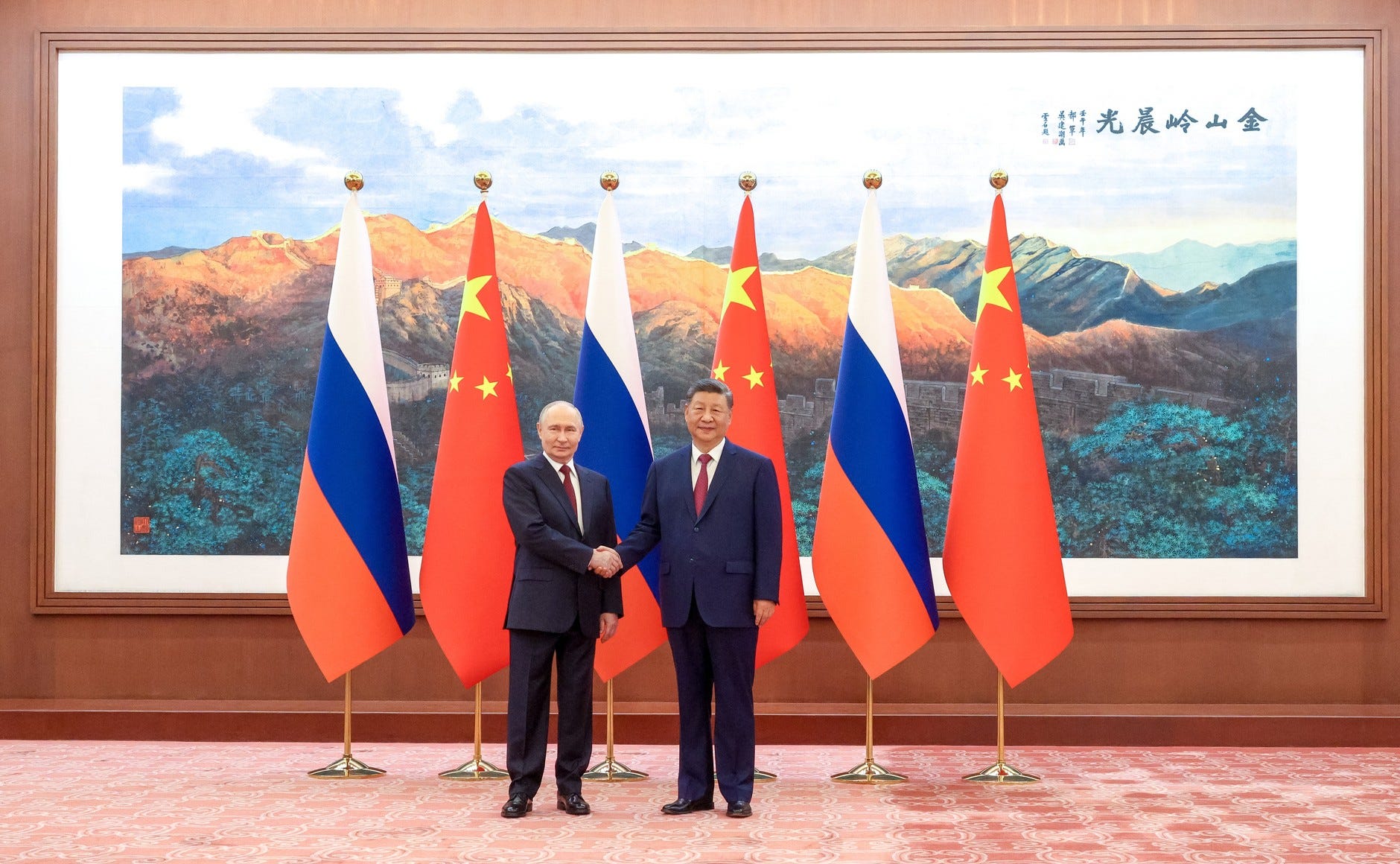
On May 19-20, Vladimir Putin paid a state visit to China where he held talks with Xi Jinping. Russia and China define their bilateral relationship as comprehensive and strategic partnership, one of the implications being that negotiations and consultations between the two countries are conducted on a regular basis and cover a broad set of issues. Moscow and Beijing take turns hosting annual summits, and every year these meetings produce an all-encompassing joint statement.
This year’s joint statement (formally the Joint Statement of the Russian Federation and the People’s Republic of China on Further Strengthening Comprehensive Partnership and Strategic Interaction, and Deepening Relations of Good-Neighbourliness, Friendship and Cooperation) includes several noteworthy paragraphs related to Russian and Chinese plans for cooperation in information technology and cyber policy.
In this post I will describe four areas of digital cooperation that are covered in the document and provide additional context.
Coding Together
Russia and China for the first time discussed software development as a new area for cooperation:
The Parties agreed to explore the possibility of establishing a mechanism for cooperation in the field of software with the aim of jointly developing digital infrastructure, strengthening cooperation and exchange on open-source issues, and promoting the adoption of high-quality open-source innovations in key industrial sectors for the joint development of both countries in this area.
For Russia, this idea fits into the broader logic of shifting away from Western software (due to security concerns but also sanctions) to domestic and open-source solutions. Russian officials often claim that the dependence on Western software solutions constitutes a new form of colonialism. Hence, Russia needs to cooperate with non-Western countries in that space.
But it’s hard to tell what would come out of this cooperation. First, as the cited paragraph suggests, the two countries are at the early stage of exploring this possibility. Second, Russian software import substitution is to a great degree built from open-source code developed by Western or international teams, not those in China. Third, Russia’s software cooperation with China—or with other countries for that matter—has natural limitations when it comes to security. Russian officials in charge of cyber security are well aware of the threat of Chinese espionage and probably won’t be excited about the prospects of allowing Chinese software into industry. The same probably holds true for China, too. The two countries’ preoccupation with digital sovereignty limits how much they can be dependent on each other’s code.
In any case, the fact that this paragraph landed in the joint statement indicates that some people in both countries believe that building software products together could be feasible and mutually beneficial.
Satellite Connections
Several paragraphs of the joint statement are focused on space cooperation. The most practical area is related to satellite programs:
The Parties agreed to deepen mutually beneficial cooperation in the field of satellite navigation, actively implement the Russian-Chinese Roadmap for Cooperation in Satellite Navigation for 2026–2030, and ensure the complementarity of the GLONASS and BeiDou navigation systems for the benefit of users worldwide.
The Parties expressed their readiness to continue strengthening Russian-Chinese cooperation in the coordination and use of radio frequencies and satellite orbits, and to continuously deepen Russian-Chinese cooperation and the exchange of experience in the field of satellite Internet and the Internet of Things.
The paragraph about satellite Internet cooperation is remarkable in the context of Russia’s approach to this issue. Since 2022, Russia has been criticizing SpaceX for providing satellite communications to the Ukrainian military. In October 2022, Russian diplomat Konstantin Vorontsov speaking at the UN threatened that Russia could take down commercial satellites used for military purposes, without explicit reference to SpaceX:
We would like to specifically stress an extremely dangerous trend that goes beyond the harmless use of outer space technologies and has become apparent during the latest developments in Ukraine. Namely, the use by the United States and its allies of civilian, including commercial, infrastructure elements in outer space for military purposes. Apparently, these States do not realise that such actions in fact constitute indirect participation in military conflicts. Quasi-civilian infrastructure may become a legitimate target for retaliation.
More recently, Russia moved away from threats to diplomatic efforts aimed at regulating low-orbit satellites used for Internet, arguing that Starlink infrastructure was used for fomenting protest in Iran. Russia also persuaded China to get on board and echo Russian concerns in the last year’s joint statement: “The Parties categorically reject any attempts to interfere in the internal affairs of states through the use of low-Earth orbit satellite internet systems.”
This time, the tone is visibly different: there is no veiled denunciation of SpaceX, instead Russia and China emphasize cooperation. Which is much needed by Russia has recently doubled down on its efforts to develop its own satellite Internet capabilities after SpaceX and Ukraine cut the Russian military off Starlink.
Commitment to Cyber Norms
The joint statement includes a usual paragraph on international information security and related UN negotiations:
The Parties intend to deepen high-level strategic cooperation on information security issues, consistently strengthen coordination in responding to threats in this area, and exchange expertise on the legislative regulation of the Internet. The Parties express concern over emerging threats to global information security. The Parties emphasize the key role of the United Nations in responding to threats in information space, support the development of dialogue and cooperation on information security issues within the framework of the Global Mechanism on Developments in the Field of ICTs in the Context of International Security and Advancing Responsible State Behavior in the Use of ICTs, adhere to the Rules of Responsible State Behavior in Information Space, and support the development of universally recognized and comprehensive international legal agreements in the field of international information security, including on issues such as data security and supply chain resilience. The Parties uphold an open, secure, stable, accessible, peaceful, and interconnected information and communications technology environment, and respect and support the principle of sovereignty in information space.
There is a slight, but noteworthy semantic difference here compared to similar paragraphs in previous Russian-Chinese joint statements and it has to do with their attitude toward the rules or responsible state behavior, also known as cyber norms. While previously Russia and China emphasized the need to further develop these rules (see the phrasings in the 2022, 2023, 2024, and 2025 joint statements), this time they stated their adherence to these rules.
Coincidentally, in recent months the Russian Foreign Ministry has been accusing Ukraine of “flagrant violation” of the UN rules of responsible state behavior in cyberspace for cyber attacks conducting cyber attacks on Russian infrastructure. Russian officials made similar accusation before, too, but without explicit reference to the cyber norms.
China’s AI Leadership
Finally, the joint statement includes multiple references to cooperation on artificial intelligence. Yet, in this area the asymmetry is pretty clear, and Russia even formally accepts China’s leadership: “The Russian Party welcomes the initiative of the Chinese Party to establish the World Artificial Intelligence Cooperation Organization;” no comparable Russian initiative is mentioned for balance.
What unites Russia and China is their intention to counter the use of AI “by certain states as a geopolitical tool to maintain their dominant position.” Those “certain states,” certainly, being the United States.
Digital cooperation is one of many areas of Russian-Chinese bilateral relation. While it’s probably not the most important pillar of their partnership, the Beijing joint statement demonstrates mutual interest in software development and satellite Internet collaboration as well as normative alignment when it comes to cyber norms and artificial intelligence. Russia and China see benefits in fostering these ties specifically as a challenge to U.S. dominance, but their cooperation has natural limits defined by both countries’ preoccupation with digital sovereignty.